


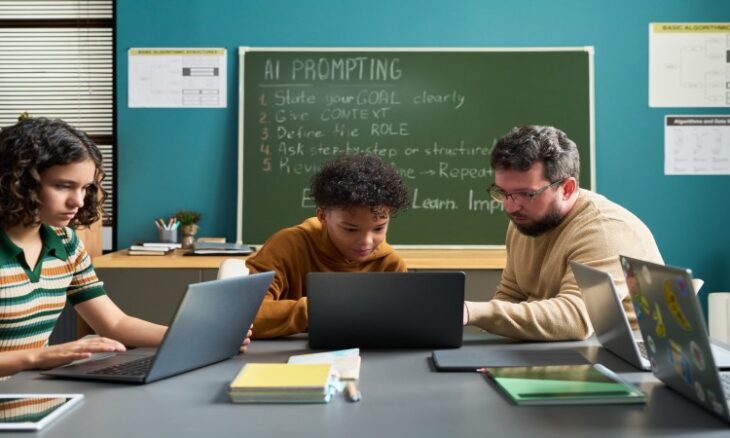
AI in Classrooms Shifts How Learning is Judged
Artificial intelligence is now embedded in classrooms, with both students and teachers already using it, while school districts continue efforts to respond. As adoption advances more rapidly than training, policy development, and structured implementation, Illuminate XR has stated that the next phase of education requires AI to be closely tied to instruction and designed to help teachers observe student learning with greater clarity.
The company has described this position as schools encounter a growing challenge inside classrooms. Outputs can now be produced quickly and with increasing sophistication, yet verifying authentic learning as it occurs has become more difficult. The issue has moved beyond whether AI will be used in schools and now centres on whether institutions can maintain authentic learning and preserve teacher judgement during instruction.
Recent research in education reflects this emerging tension. In 2025, RAND reported that 54% of students and 53% of teachers across English language arts, mathematics, and science were using AI for school-related work. However, only 35% of district leaders indicated that their districts provided students with training on AI use. More than 80% of students reported that teachers had not explicitly instructed them on how to apply AI in schoolwork, while only 45% of principals stated that an AI-use policy had been established in their schools.
Teachers are therefore required to make significant decisions about student work in an environment where refined answers can be generated within minutes. Some schools have responded by introducing AI detection tools and tougher enforcement measures, while others have permitted broader AI use without establishing a defined instructional framework. In both approaches, teachers remain responsible for determining what constitutes reliable evidence of student understanding.
Illuminate XR has indicated that correct answers on their own are no longer sufficient indicators of learning, particularly when AI tools can generate responses independently. The emphasis has shifted to making certain that students can demonstrate insight beyond the final output, including their ability to explain processes, apply knowledge, and interact with the material in purposeful ways.
The company has also noted that many existing AI tools within education are designed primarily to improve efficiency by generating content, summarising materials, and automating instructional workflows. While these functions may support teachers in managing tasks, IXR Nexus has been developed with a different focus: supporting teachers within the learning process itself rather than outside it.
IXR Nexus is designed to operate within existing learning management systems used by schools, including Canvas and Google Classroom. Instead of functioning as a separate application, it integrates into the places where learning activities occur, with the stated aim of permitting teachers to observe learner involvement and progress in real time.
The system focuses on identifying observable academic behaviours while students are actively working. These include indicators such as the use of strategies, reflection on tasks, adjustment of approaches, productive struggle, and purposeful engagement with assigned work. Illuminate XR has stated that such signals are increasingly important in a classroom context where completed outputs alone are no longer considered reliable evidence of understanding.
The company has further stated that while efficiency gains from AI tools can provide concrete benefits, they are not sufficient in isolation. Schools require systems that allow teachers to maintain depth in learning, apply professional judgement, and sustain trust within the instructional process. It has also been noted that students may submit polished work without demonstrating deeper levels of thinking, making it necessary to assess their ability to explain, apply, and reflect on their work consistently.
Illuminate XR has emphasised that responsible use of AI in education must be defined not only by what systems are capable of doing, but also by the limits placed on their role. IXR Nexus is designed to remain focused on instruction and does not extend into areas such as counselling or therapeutic support. Its function is limited to directing learning, supporting thinking, and identifying academic patterns as students work through tasks.
In situations that require judgment related to care, safety, or situational understanding, the system is designed to defer to qualified professionals. Illuminate XR has stated that maintaining this boundary is essential at a time when schools are still determining how far AI should extend within student experiences and decision-making procedures.
The company has stated that its approach is not intended to replace teacher judgment but to help educators in observing the learning process more clearly, particularly during moments that may otherwise be difficult to detect from final outputs alone.
Illuminate XR has stated that the next phase of AI within education is not centred on increasing the number of tools in use, but on applying AI with defined boundaries, transparency, and continued educator authority. The focus, as described, is on making certain that systems support trust, preserve depth in learning, and protect authentic student thinking as adoption continues to expand across institutions.
Illuminate XR is developing infrastructure intended to strengthen and measure human skills that cannot be replicated by AI systems. Through its IXR Nexus platform, the company assists educators in rendering learning behaviours visible in real time, with a focus on metacognition, critical thinking, communication, and adaptability. The system has been created with a focus on safety and governance, supporting primary, secondary, and higher education institutions in adjusting to changing classroom conditions.